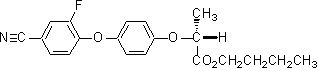
Chemical Abstracts name
Butyl (R)-2-[4-(4-cyano-2-fluorophenoxy)phenoxy]propanoate
Biochemistry Fatty acid synthesis inhibitor, by inhibition of acetyl CoA carboxylase (ACCase). Selectivity between susceptible grasses and dicotyledonous plants is attributed to the forms of ACCase present and their compartmentalisation within plant cells. Susceptible grasses contain the susceptible eukaryotic form of ACCase; dicotyledonous plants contain both susceptible eukaryotic and herbicide-resistant prokaryotic forms of ACCase, rendering them resistant to cyhalofop-butyl. Rice tolerance to cyhalofop-butyl is due to rapid metabolism to the herbicidally inactive diacid (DT50 <10 h), whereas susceptible grasses metabolise cyhalofop-butyl to the herbicidally active monoacid.
Mode of action Post-emergence herbicide with foliar uptake only and no soil activity. A systemic herbicide that is readily absorbed by plant tissue, is moderately phloem-mobile and accumulates in meristematic regions. Grass weeds cease growth immediately after treatment, with yellow patches appearing within 2-3 days to one week, leading to necrosis and death of the whole plant within 2 to 3 weeks.
Uses For post-emergence control of grass weeds in rice. Applied at 75-100 g/ha in tropical rice and 180-310 g/ha in temperate rice. For selectivity in Poaceae species.
Phytotoxicity Rice is completely tolerant to cyhalofop-butyl, due to rapid metabolism to the inactive diacid.
Compatibility Not compatible with most broad-leaved and sedge auxin and ALS herbicide products.
Formulation 10%EC, 18%EC
Standard of 97%TC
|
Testing Items |
Standard % (w/w) |
|
Appearance: |
White powder |
|
Content: |
≥97.0 |
|
Water: |
≤0.5 |
|
PH value: |
4.5-7.0 |
|
Insoluble in Acetone: |
≤0.5 |